Le Mirage
The Spy Who Came in from the ColdLe Mirage is a small bungalow near the dunes at Scheveningen, presented as a welcoming guesthouse but used as a controlled interrogation site for Alec Leamas. Its domestic hospitality—the smiling hostess, lunch, whisky, lace curtains and potted plants—frames the beginning of a calculated extraction of intelligence, while the questions asked inside it set in motion suspicions that will become central to the case against Mundt.
Setting and Arrival
The bungalow stands at the near end of a row of villas bordering the dunes on the sea front, northwest of The Hague. A wrought-iron sign on its porch gives its name in pale blue Gothic script. Though a notice in the window says every room is taken, a woman arrives at the door and welcomes Leamas and Kiever. Her pleasure seems directed toward the car as much as its passengers; she comes down the drive smiling, then greets them again inside, asking whether the journey was good. The warmth is almost conspicuously ordinary, at odds with the surveillance surrounding their arrival.
Leamas has reason to read the scene as managed. The Dutch-registered Volkswagen that brings him and Kiever is driven by a woman who ignores them, stops at amber lights, and appears to follow a briefing. Leamas suspects another car is tracking them, watches the wing mirror, and notices a black car parked down the road as they reach the bungalow. A man in a raincoat gets out. The house’s invitation to enter therefore arrives in a setting of observation and uncertainty: hospitality provides the cover, not reassurance.
The Interrogation Begins
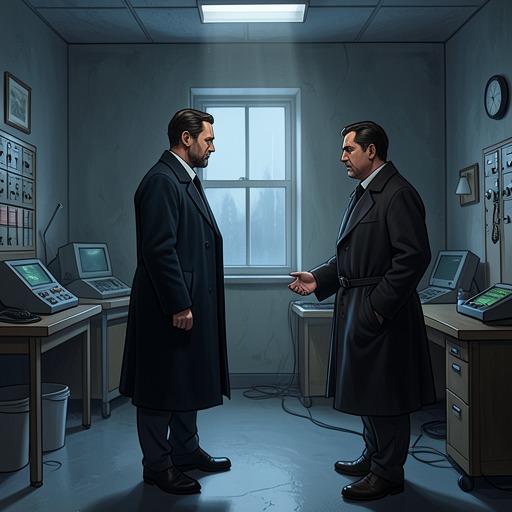
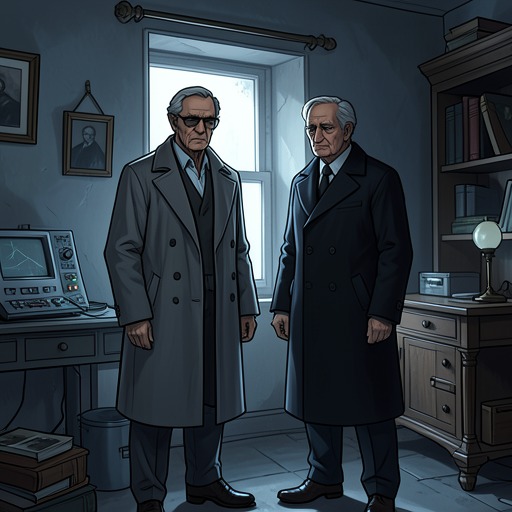
After Kiever leaves, Peters leads Leamas into a back room. Heavy lace curtains, ornate fringe, potted plants—including cacti and a tobacco plant—and pseudo-antique furniture make the room feel furnished for domestic comfort. Yet its arrangement is functional. A table covered with a rust-coloured counterpane holds a pad of paper and pencil before each carved chair; whisky and soda wait on a sideboard. Peters mixes drinks, but the paired writing materials signal that the encounter is an interview whose answers will be recorded and pursued.
Leamas rejects the performance of personal goodwill, telling Peters that they both know their business and that Peters should not pretend to have fallen in love with him. His suspicion is sharpened by the mismatch between the agreeable house and the professional transaction: he is a paid defector, and the bungalow is where that claim is tested. Peters answers that Kiever had described him as proud and links the assault on tradesmen to that supposed pride. The exchange establishes the interrogation’s method: personal character and staged conduct are treated as evidence, while the setting makes coercive scrutiny look like a private conversation.
Lunch interrupts the questioning. The hostess brings in an enormous meal of cold meats, bread, and soup; Peters puts his notes aside, and the men eat in silence. The pause does not end the interrogation but marks its beginning. Once lunch is cleared, Peters resumes asking about Leamas’s return to the Circus and his work there. At Le Mirage, routine hospitality and the taking of testimony are not separate activities: food and drink sustain the long questioning that follows.
From Riemeck to Rolling Stone
The conversation expands from Leamas’s career into the intelligence he claims to have handled. Peters challenges the plausibility of the material attributed to Karl Riemeck, asking whether all of it could really have come from Riemeck alone. Leamas answers that Riemeck had access, but Peters believes he must have had help. That doubt stays with Leamas after the questioning: he recalls that Control had raised the same issue, and begins to wonder whether both men are protecting or pursuing knowledge of a high-level collaborator. The bungalow is thus the first setting in which a repeated question about Riemeck becomes more than a dispute over the scale of his access.
As the interrogation proceeds, Leamas gives an account of his Berlin organization—its procedures, communications, staff, flats, transport, and recording and photographic equipment. He recognizes afterward that he has betrayed what he knows of Allied Intelligence in Berlin. When Fiedler later argues that the disclosed material is not worth the proposed price, he distinguishes this old intelligence from Rolling Stone and insists that Leamas has not yet told them what he knows. The inquiry begun in the bungalow therefore opens onto a larger problem: what the evidence can establish about an unidentified spy, and whether the disclosures are sufficient to explain the operation.
The Evidence and Its Reversal
The questions about Riemeck acquire a more specific force when Fiedler presents the Copenhagen bank evidence. Leamas had deposited money under the name Robert Lang; the co-signatory withdrew the full ten thousand dollars a week later, on a date coinciding with Mundt’s visit to Denmark under an alias. At the Tribunal, Fiedler also relates Leamas’s Helsinki deposit to Mundt’s subsequent clandestine journey to Finland. These later disclosures give retrospective weight to the earlier insistence at Le Mirage that Riemeck must have had help: the interrogation’s uncertainty over access and collaboration belongs to a deliberately constructed trail of clues.
The final reversal comes when Leamas suddenly understands the trick in which he has been caught. Le Mirage itself does not disclose the whole design, and its placid room offers no answer to the questions raised there. Its significance lies in being the first interior of the staged defection where information is coaxed from Leamas and then assessed for what it can imply. The bungalow’s domestic surface and its documentary apparatus—the paired pads and pencils, Peters’s notes, the repeated questioning—anticipate the novel’s larger conflict between appearances and inference, in which evidence can be accurate yet arranged to mislead.